Healthcare Logistics
Healthcare Logistics: When Complexity Creates Opportunity
Healthcare logistics has become one of the attractive corners of the healthcare value chain. As care delivery shifts away from hospitals, therapies become more complex, and health systems consolidate at scale, the movement of medical products is no longer a simple transportation problem. It has become a mission-critical operating layer of modern healthcare.
Three downstream segments sit at the center of this transformation: Medical Courier Services, Clinical Trial Supply Chain Services, and Specialty Courier Services. Each of these specialized segments is characterized by recurring demand and limited scaled competition, creating an opportunity to build defensible, tech-enabled platforms that provide enhanced logistics capabilities and enable expanded service breadth.
Medical Courier Services: Logistics Backbone of the Modern Integrated Delivery Networks (IDNs)
Medical courier services form the last-mile infrastructure that moves specimens, pharmaceuticals, medical supplies, and devices between hospitals, laboratories, outpatient centers, pharmacies, and patient homes. Historically, this function was fragmented and largely managed in-house, with individual departments running ad-hoc routes that were inefficient, duplicative, and difficult to scale.
With hospitals consolidating into large IDNs, logistics requirements have evolved and become significantly more complicated. Modern IDNs now operate multi-facility care networks that require coordinated, system-wide logistics. In response, a new courier model has emerged, exemplified by platforms such as MedSpeed that are focused on scheduled, optimized, and centrally managed logistics networks.
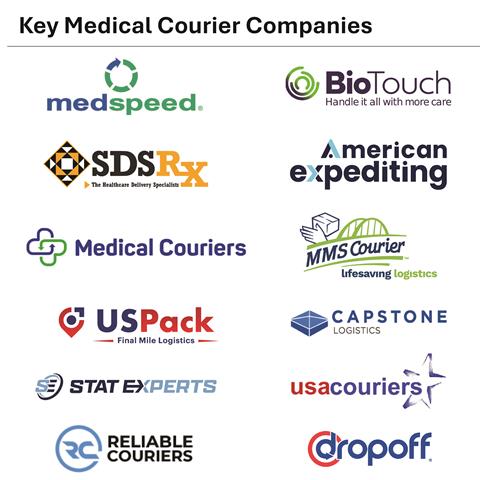
These providers replace fragmented point-to-point routing with hub-and-spoke models, optimized schedules, and standardized service levels across the entire health system. Today, roughly 50-60% of IDNs have transitioned from in-house courier models to centralized, outsourced logistics platforms.
Once embedded, these providers benefit from sticky, multi-year contracts and deep operational integration, making them natural platforms for expanding into pharmacy distribution, lab transport, medical device movement, and home-based care.
Clinical Trial Supply Chain Services: High-Growth Segment With White Space for Platform Expansion
Clinical trial logistics sits at the center of an increasingly complex global drug development ecosystem. Providers manage the movement of investigational drugs, biological specimens, and trial materials under tight regulatory and temperature constraints, across manufacturers, depots, trial sites, and patients often spanning multiple countries.
Growth in this segment is accelerating as pharma R&D spending rises, outsourcing increases, and investigational therapies become more complex. Sponsors expect outsourced clinical logistics to grow by approximately 50%, with advanced modalities such as biologics and cell and gene therapy (CGT) driving demand for highly specialized cold-chain capabilities.
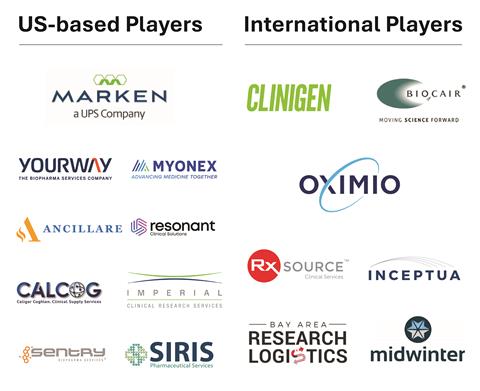
While UPS/Marken leads the large-pharma segment, meaningful whitespace exists among mid-sized and emerging biopharma and Contract Research Organizations (CROs), which require more flexible, technology-enabled partners.
In response, mid-market providers such as Yourway, Biocair, Clinigen, and others are expanding beyond transportation into kitting, secondary packaging, labeling, depot services, and comparator sourcing.
Here, the opportunity is to transform transport-centric operators into end-to-end clinical supply chain platforms by combining logistics, storage, packaging, and data visibility into a differentiated, scalable offering.
Specialty Courier Services: Fast-Growing, High-Barrier Segment
Specialty courier services serve the most technically demanding and time-critical segments of healthcare logistics, including CGT, radiopharmaceuticals, and organ transport. These shipments require cryogenic handling, validated chain-of-identity, and precise coordination across air and ground networks, often within extremely narrow time windows.
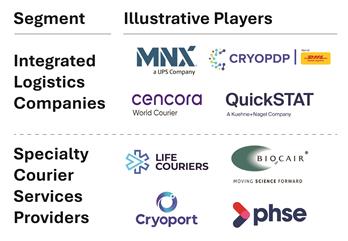
Only several operators, such as CRYOPDP, QuickSTAT, MNX, and Life Couriers, possess the regulatory infrastructure and technical capabilities to operate in these environments at scale. Market growth is driven by accelerating CGT commercialization, rising use of nuclear oncology therapies, and expanding organ transplant activity enabled by regulatory changes and advances in preservation technology.
The result is a high-growth, high-barrier market segment with limited competition and strong strategic interest from global logistics integrators. For PE investors, specialty couriers offer one of the most defensible niches in healthcare logistics, well suited to capability-driven roll-ups.
Why Healthcare Logistics Is a Compelling PE Investment Area
Across medical couriers, clinical trial logistics, and specialty transport, platforms benefit from long-term contracts, high switching costs, regulatory complexity, and deep customer integration, all of which support stable cash flow and defensible margins.
At the same time, Healthcare Logistics offers multiple paths to value creation: geographic expansion, service-line extension, and capability-driven M&A. Strategic acquirers continue to move downstream into healthcare logistics, while PE-backed platforms are scaling rapidly, creating clear and attractive exit pathways.
In short, healthcare logistics is no longer just about moving boxes. It has become a mission-critical, technology-enabled infrastructure layer of modern healthcare and one of the attractive areas for PE firms to build high-growth platforms.
To request the full article, please click below.
To learn more about Healthcare Logistics, please contact:
insights@gcpny.com